Latest Products
Showing posts with label Internet. Show all posts
Application server

Application server

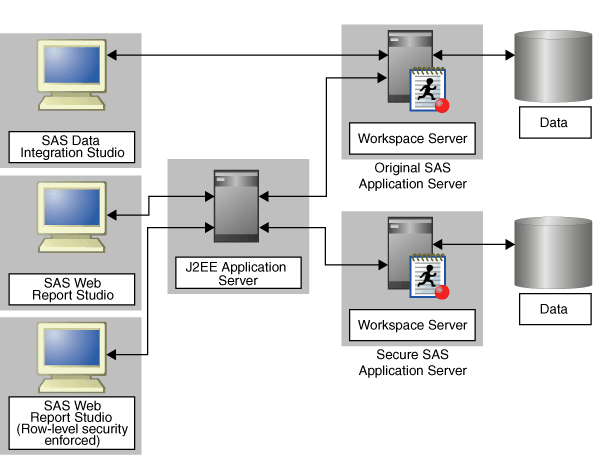
        An application server is a software framework that provides an environment where applications can run, no matter what the applications are or what they do.[1] It is dedicated to the efficient execution of procedures (programs, routines, scripts) for supporting the construction of applications.
       The term was originally used when discussing early client–server systems to differentiate servers that run SQL services[2] and middleware servers from file servers.
Later, the term took on the meaning of Web applications, but has since evolved further into more of a comprehensive service layer. 

       An application server acts as a set of components accessible to the software developer through an API defined by the platform itself. For Web applications, these components are usually performed in the same machine where the Web server is running, and their main job is to support the construction of dynamic pages. However, present-day application servers target much more than just Web pages generation, they implement services like clustering, fail-over and load-balancing, so developers can be focused just on implementing the business logic.[3]


       Normally the term refers to Java application servers. When this is the case, the application server behaves like an extended virtual machine for the running applications, handling transparently connections to the database at one side, and connections to the Web client at the other.
        An application server is a software framework that provides an environment where applications can run, no matter what the applications are or what they do.[1] It is dedicated to the efficient execution of procedures (programs, routines, scripts) for supporting the construction of applications.

       The term was originally used when discussing early client–server systems to differentiate servers that run SQL services[2] and middleware servers from file servers.
Later, the term took on the meaning of Web applications, but has since evolved further into more of a comprehensive service layer. 

       An application server acts as a set of components accessible to the software developer through an API defined by the platform itself. For Web applications, these components are usually performed in the same machine where the Web server is running, and their main job is to support the construction of dynamic pages. However, present-day application servers target much more than just Web pages generation, they implement services like clustering, fail-over and load-balancing, so developers can be focused just on implementing the business logic.[3]


       Normally the term refers to Java application servers. When this is the case, the application server behaves like an extended virtual machine for the running applications, handling transparently connections to the database at one side, and connections to the Web client at the other.
Application server
View detail
Ektranet

Ektranet

          An extranet is a computer network that allows controlled access from the outside, for specific business or educational purposes.

         An extranet can be viewed as an extension of a company's intranet that is extended to users outside the company, usually partners, vendors, and suppliers. It has also been described as a "state of mind" in which the Internet is perceived as a way to do business with a selected set of other companies (business-to-business, B2B), in isolation from all other Internet users.
wirelesszonee.blogspot.com


      In contrast, business-to-consumer (B2C) models involve known servers of one or more companies, communicating with previously unknown consumer users. An extranet is like a DMZ in that it provides access to needed services for channel partners, without granting access to an organization's entire network.
          An extranet is a computer network that allows controlled access from the outside, for specific business or educational purposes.

         An extranet can be viewed as an extension of a company's intranet that is extended to users outside the company, usually partners, vendors, and suppliers. It has also been described as a "state of mind" in which the Internet is perceived as a way to do business with a selected set of other companies (business-to-business, B2B), in isolation from all other Internet users.
wirelesszonee.blogspot.com


      In contrast, business-to-consumer (B2C) models involve known servers of one or more companies, communicating with previously unknown consumer users. An extranet is like a DMZ in that it provides access to needed services for channel partners, without granting access to an organization's entire network.
Ektranet
View detail
Internet

Internet

     The Internet is a global system of interconnected computer networks that use the standard Internet Protocol Suite (TCP/IP) to serve billions of users worldwide.
It is a network of networks that consists of millions of private, public, academic, business, and government networks, of local to global scope, that are linked by a broad array of electronic, wireless and optical networking technologies. The Internet carries a vast range ofinformation resources and services, such as the inter-linked hypertext documents of the World Wide Web (WWW) and the infrastructure to support electronic mail.

       Most traditional communications media including telephone, music, film, and television are reshaped or redefined by the Internet, giving birth to new services such as Voice over Internet Protocol (VoIP) and IPTV. Newspaper, book and other print publishing are adapting to Web sitetechnology, or are reshaped into blogging and web feeds. The Internet has enabled or accelerated new forms of human interactions throughinstant messaging, Internet forums, and social networking. Online shopping has boomed both for major retail outlets and small artisans and traders. Business-to-business and financial services on the Internet affect supply chains across entire industries.


           The origins of the Internet reach back to research of the 1960s, commissioned by the United States government in collaboration with private commercial interests to build robust, fault-tolerant, and distributed computer networks. The funding of a new U.S. backbone by the National Science Foundation in the 1980s, as well as private funding for other commercial backbones, led to worldwide participation in the development of new networking technologies, and the merger of many networks. The commercialization of what was by the 1990s an international network resulted in its popularization and incorporation into virtually every aspect of modern human life. As of 2009, an estimated quarter of Earth's population used the services of the Internet.


             The Internet has no centralized governance in either technological implementation or policies for access and usage; each constituent network sets its own standards. Only the overreaching definitions of the two principal name spaces in the Internet, the Internet Protocol address space and the Domain Name System, are directed by a maintainer organization, the Internet Corporation for Assigned Names and Numbers (ICANN). 


            The technical underpinning and standardization of the core protocols (IPv4 and IPv6) is an activity of the Internet Engineering Task Force (IETF), a non-profit organization of loosely affiliated international participants that anyone may associate with by contributing technical expertise.
     The Internet is a global system of interconnected computer networks that use the standard Internet Protocol Suite (TCP/IP) to serve billions of users worldwide.
It is a network of networks that consists of millions of private, public, academic, business, and government networks, of local to global scope, that are linked by a broad array of electronic, wireless and optical networking technologies. The Internet carries a vast range ofinformation resources and services, such as the inter-linked hypertext documents of the World Wide Web (WWW) and the infrastructure to support electronic mail.

       Most traditional communications media including telephone, music, film, and television are reshaped or redefined by the Internet, giving birth to new services such as Voice over Internet Protocol (VoIP) and IPTV. Newspaper, book and other print publishing are adapting to Web sitetechnology, or are reshaped into blogging and web feeds. The Internet has enabled or accelerated new forms of human interactions throughinstant messaging, Internet forums, and social networking. Online shopping has boomed both for major retail outlets and small artisans and traders. Business-to-business and financial services on the Internet affect supply chains across entire industries.


           The origins of the Internet reach back to research of the 1960s, commissioned by the United States government in collaboration with private commercial interests to build robust, fault-tolerant, and distributed computer networks. The funding of a new U.S. backbone by the National Science Foundation in the 1980s, as well as private funding for other commercial backbones, led to worldwide participation in the development of new networking technologies, and the merger of many networks. The commercialization of what was by the 1990s an international network resulted in its popularization and incorporation into virtually every aspect of modern human life. As of 2009, an estimated quarter of Earth's population used the services of the Internet.


             The Internet has no centralized governance in either technological implementation or policies for access and usage; each constituent network sets its own standards. Only the overreaching definitions of the two principal name spaces in the Internet, the Internet Protocol address space and the Domain Name System, are directed by a maintainer organization, the Internet Corporation for Assigned Names and Numbers (ICANN). 


            The technical underpinning and standardization of the core protocols (IPv4 and IPv6) is an activity of the Internet Engineering Task Force (IETF), a non-profit organization of loosely affiliated international participants that anyone may associate with by contributing technical expertise.
Internet
https://blogger.googleusercontent.com/img/b/R29vZ2xl/AVvXsEi7AA_am3OdzkBUGUNrh0KRqP6uS6kWnZ6dtzPqDI42N4h3_0X0NXD4VAMx-uSy44Jd-dThlv4cJWYCxD02JDZ9cbozxTKy1a3sdCcFHtX4oRZUl3_rq4lrovufaM9mZLJaS1bJXFssyA87/s72-c/internet.jpg
View detail
 
Support : Creating Website | B-ALL SHOP | Mas Template
Copyright © 2015. Wireless iPhone4 - All Rights Reserved
Template Created by Creating Website Published by Mas Template
Proudly powered by Blogger